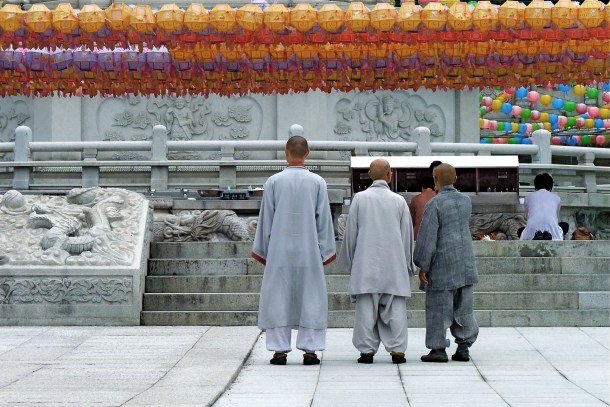
Three Monks at Donghwasa Temple/동화사

Three Monks at Donghwasa Temple/동화사
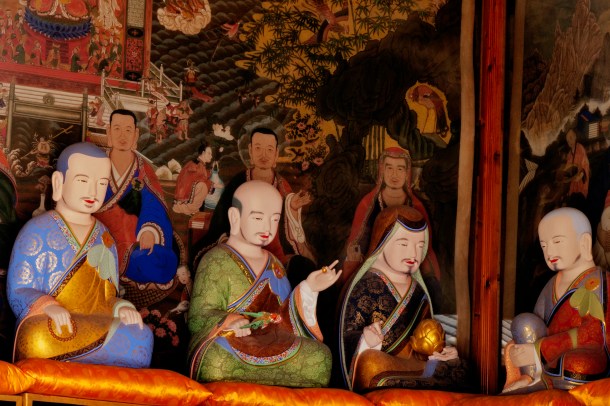
An interior shot at Tongdosa Temple/통도사 – South Korea
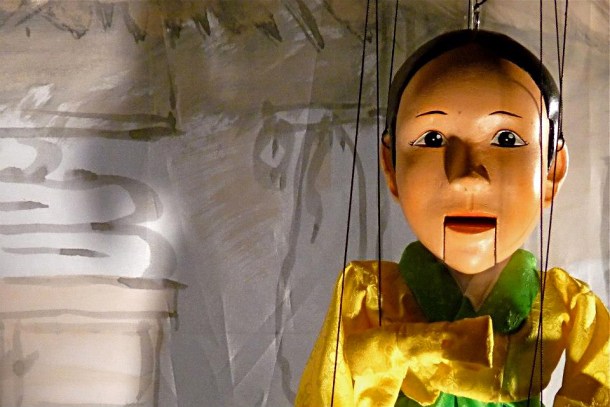
A traditional Korean marionette show in Chilgok, South Korea.

A young boy waits to see the changing of the guard at Seoul’s Gyeongbokgung Palace.
초등학교 유리창마다
석양이 빛나고 있다
그 유리창 하나하나가 실컷 신들이었다
-고은
the setting sun shines through
each elementary school window
every one of those windows was an illimitable god
-Ko Un
———————————-
This is poem 49 from Flowers of a Moment, which is a small volume of poetry by Korean author Ko Un that I am currently translating into English.
아우슈비츠에 가서
쌓인 안경들을 보았다
쌓인 산더미 신발들을 보았다
돌아오는 길
서로 다른 창 밖을 바라보았다
-고은
I went to Auschwitz
and saw the piles of glasses
and the mountains of stacked shoes.
On the way back,
I gazed out of a different window.
-Ko Un
———————————-
This is poem 24 from Flowers of a Moment, which is a small volume of poetry by Korean author Ko Un that I am currently translating into English.
On October 9th, it was announced that French author Patrick Modiano will be the recipient of the 2014 Nobel Prize in Literature. In the wake of this news, many in South Korea’s literary circles are once again asking themselves when a Korean author will claim the coveted prize. Since 1901 the Nobel Prize in Literature has been awarded to 111 Laureates, yet a Korean author has never collected the honor.
In discussions with foreign publishers, Korean literary agent Joseph Lee discovered that Nobel Prize winning authors generally have two things in common: Usually, their works have been translated into at least 15-20 languages AND they have a “loyal readership in their own country.” Journalist Chung Ah-young has reported that over the last five years the average Korean spends only 26 minutes per day reading. How can Korea promote their literature to a global audience if they are having a hard time doing so at home? Fortunately, the quantity and quality of translations of Korean literature are improving every year, something which has often been a stumbling block in gaining more recognition and a larger readership from the global community.
Ko Un (81) is frequently mentioned as a favorite for the Nobel Prize in Literature. So much so, that reporters usually camp outside Ko’s home ahead of the yearly Nobel recipient announcement. Ko is a prolific poet and novelist whose career has spanned over five decades. His work has been influenced by the traumas which he experienced during the Korean War, his involvement with the Democracy Movement of the 1970’s and early 80’s, as well as by the ten years that he spent living as a Buddhist monk before he began writing in earnest.
Almost every article I read on South Korea’s prospects of receiving a Nobel Prize in Literature mentioned Ko Un, yet I had never heard of him and his work before last week. Moreover, I didn’t know any of the other Korean writers who are also considered to be strong contenders for the Literature Prize, authors such as Hwang Sok-yong and Lee Seung-u. 2008 Nobel Laureate Jean-Marie Gustave Le Clézio has mentioned both Hwang and Lee as possible future recipients of the Nobel Literature Prize.
After learning about who South Korea’s most esteemed authors are, I had a strong desire to investigate their work. My Korean language study has now progressed to a point where reading Korean books without translation can realistically be used as a learning tool rather than as an exercise in frustration and dictionary hopping. I am not yet at a stage where I can pick up any book and read it from front to back without a translator, but I am certainly able to read for pleasure with occasional rest stops for clarification and meaning.
Due to Ko Un’s standing as Korea’s most promising bet for the Nobel Prize in Literature, I decided to start with his work. I didn’t want to bite off more than I could chew as I am currently engaged in several other time-consuming writing and Korean study projects. I elected to begin with a collection of 185 short poems entitled Flowers of a Moment (순간의 꽃), put out by Munhakdongne Publishing Company. It is a slender volume of 118 pages and most of those pages only contain between six and eight lines of verse. Ko sets the tone for the collection with the following brief introduction:
해가 진다
내 소원 하나
살찐 보름달 아래 늑대 되리
the sun sinks.
my only wish
is to be a wolf under a corpulent full moon.

As I delved further into Ko’s poems, it occurred to me that I could kill two birds with one stone by using them to study for the TOPIK II Korean Language exam, which I hope to take in the Spring of 2015. On account of Flowers of a Moment’s slim size, I believe that it is ideally suited for translation practice and because I write poetry myself, I feel that the translation work will hold my interest for the duration of the project. This morning I began with the volume’s first four poems. At this rate, I expect the translation to be completed by the end of December.
In 2006, a translation of Flowers of a Moment by Young-moo Kim was published by BOA Editions Ltd. For me, the exciting aspect of this translation project is that an English translation already exists. You see, I am not a translator by trade. I don’t have a degree in Korean Language or a certification that would qualify me to do this kind of work professionally. Yes, I did pass the Basic Level Korean Language Exam, but so have many other language hobbyists who share my interest in Korean. After I finish my work, I plan to compare it with the BOA edition in order to see if the essence of my translation is truthful. I will be curious to examine how my work holds up, if it does at all.
I am still learning Korean and translation is not an exact science, therefore if my version of Flowers of a Moment falls short of being a passable translation, I won’t judge myself too harshly. During this journey, I may occasionally post a snippet of whatever poem I happen to be working on at the time. In January, when the work is finished, I will update the blog with an analysis of the project.
For now I leave you with the first poem from Flowers of a Moment.
today was spent in somebody’s story
on the path home,
trees are watching me
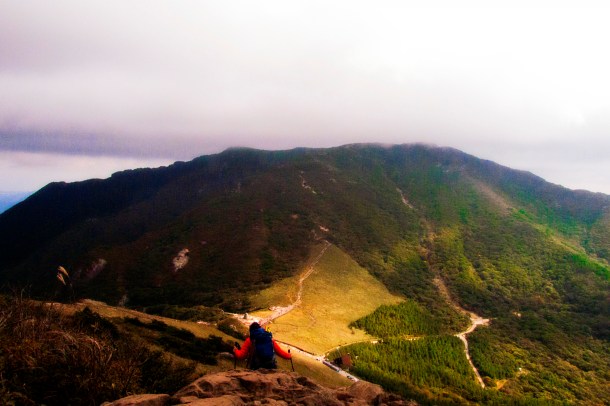
A hiker descending Sinbul Mountain/ 등산객은 신불산을 내려가고 있다
This was a fabulous hike! It was quite challenging and a great deal of fun.
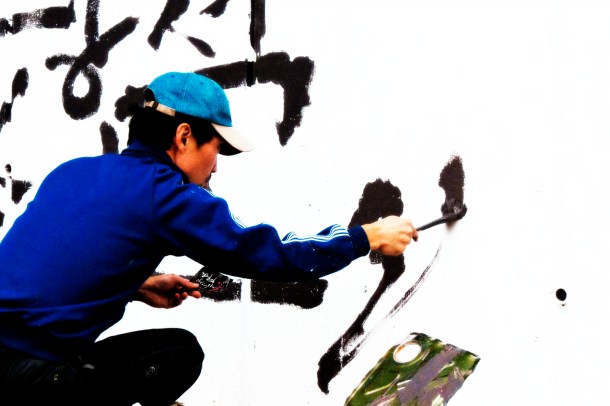
A painter adding his contribution to the Kim Kwang-seok Alley Mural/김광석 골목의 벽화
Daegu, South Korea/대한민국, 대구
Lonely hearts bloom in old country homes
where rice wine once flowed through
uneventful existences; now, sophisticated
city wombs decline rural lips while sharp
mouths lament of lost traditions
beneath a blushing strawberry moon.
New paths need new feet.
Life is hard on dusty roads of discontent;
bright lights beckon young ladies with
promises of luxury and liberty as brothers
stay behind to reap a hollow harvest in
an era of transplantation and transmutation.
Would-be wives stretch for the stars above
forsaken farmers who dig their heels in,
waiting for clock hands to turn back.
New paths need new feet.
From foreign ports, fair faces appear to
work in familial gardens, seeking a better
life within sunrise’s coveted serenity.
Shall these hopeful flowers take root in
the domestic fold? – Or, will their
petals wither with the lavender ladies?
New paths need new feet.
 sundry folly