자정
텅 빈 거리에서
눈송이가 내 이마에 내린다
빛 없이 길을 잃었어요
at midnight
on a deserted street
snowflakes fall upon my brow
without light I am lost

자정
텅 빈 거리에서
눈송이가 내 이마에 내린다
빛 없이 길을 잃었어요
at midnight
on a deserted street
snowflakes fall upon my brow
without light I am lost
아우슈비츠에 가서
쌓인 안경들을 보았다
쌓인 산더미 신발들을 보았다
돌아오는 길
서로 다른 창 밖을 바라보았다
-고은
I went to Auschwitz
and saw the piles of glasses
and the mountains of stacked shoes.
On the way back,
I gazed out of a different window.
-Ko Un
———————————-
This is poem 24 from Flowers of a Moment, which is a small volume of poetry by Korean author Ko Un that I am currently translating into English.

A hairpiece from the 2013 DAEGU INTERNATIONAL BODYPAINTING FESTIVAL
Macbeth is standing beside Lady Macbeth’s bier
Macbeth– How came we to this lowly state,
marred by jealousy and by hate?
So loathsome is this wicked strife
which robbed the breath of lady life.
If only I could turn back time
when nights were serene, and sublime.
Lord of that gent, I cannot be
and now I float in sordid sea.
At times it was a thankless treat
subsisting with this bitter Sweet,
For she ruled with an iron hand
which shook the waters and the land.
Although my dame was hot and strong
to me, her deeds could not be wrong.
Our love was ardent, rare, and true;
a kind those hags shall never brew.
This tribute that I grant her ghost,
my body cold can barely host.
By God’s grace she vacates this skin
to stand and answer for her sin.
Curses upon such endless shame
for which I alone bear the blame.
Enter an attendant
Attendant– I know that this most tragic loss
burdens you with a heavy cross.
But good Sir, you must come away.
Hasten thy heels without delay.
Macbeth– After I shroud her faded form,
I shall follow, to greet the storm.
Exit attendant
Macbeth covers Lady Macbeth with a shroud
Slumber soundly, fair dreaming dear
there is nothing for you to fear.
Exit Macbeth
———————————————–
This is one of my oldest creative works; I originally penned this when I was in high school some 15 years ago. I dusted it off today and cleaned up the verse. I would have been far too embarrassed to post the original.
Shakespeare never wrote a scene where the title character deals with his wife’s death. This is my version of what *could* have happened in the play. I would like to offer my sincerest apologies to the Bard for butchering his work. Also, this is not in iambic pentameter. Perhaps, one day it will be!
어두운 하늘로 도망가기 전에
우아한 참새는 오늘 꿈들이 없을 거라고 선포했다
나뭇가지가 건드렁거린다
땅에 쓰러지는 동안 작은 도토리는 듣지 말라고 운다
before flying away into a dark sky
an elegant sparrow declared that there would be no dreams today
tree branches sway
as it falls to the earth a little acorn cries, do not listen
———————-
This is the first Korean poem that I ever wrote. I wrote it in 2012, when I knew nothing about how to format quoted speech in Korean. I took some time this morning to fix the quoted speech and to clean up the verse. I don’t think that it is a particularly strong poem, but I did want to share it.
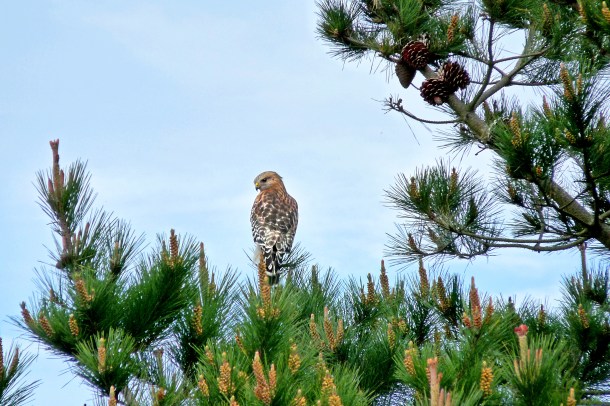
A hawk that we spotted at San Francisco’s Lake Merced.
(2012)
My hazy head slumps down by the river of forgetfulness as
it mumbles of the shadowed land which waits for no one.
Paralyzed eyes lead listless limbs towards the winged
zealot who shall transport me to the realm of oblivion, yet
I do not fight the persuasive hands that grab at me for
this daunting day has already slithered into history’s
grip; the poppies pull is far too powerful.
At your cave I stand.
On October 9th, it was announced that French author Patrick Modiano will be the recipient of the 2014 Nobel Prize in Literature. In the wake of this news, many in South Korea’s literary circles are once again asking themselves when a Korean author will claim the coveted prize. Since 1901 the Nobel Prize in Literature has been awarded to 111 Laureates, yet a Korean author has never collected the honor.
In discussions with foreign publishers, Korean literary agent Joseph Lee discovered that Nobel Prize winning authors generally have two things in common: Usually, their works have been translated into at least 15-20 languages AND they have a “loyal readership in their own country.” Journalist Chung Ah-young has reported that over the last five years the average Korean spends only 26 minutes per day reading. How can Korea promote their literature to a global audience if they are having a hard time doing so at home? Fortunately, the quantity and quality of translations of Korean literature are improving every year, something which has often been a stumbling block in gaining more recognition and a larger readership from the global community.
Ko Un (81) is frequently mentioned as a favorite for the Nobel Prize in Literature. So much so, that reporters usually camp outside Ko’s home ahead of the yearly Nobel recipient announcement. Ko is a prolific poet and novelist whose career has spanned over five decades. His work has been influenced by the traumas which he experienced during the Korean War, his involvement with the Democracy Movement of the 1970’s and early 80’s, as well as by the ten years that he spent living as a Buddhist monk before he began writing in earnest.
Almost every article I read on South Korea’s prospects of receiving a Nobel Prize in Literature mentioned Ko Un, yet I had never heard of him and his work before last week. Moreover, I didn’t know any of the other Korean writers who are also considered to be strong contenders for the Literature Prize, authors such as Hwang Sok-yong and Lee Seung-u. 2008 Nobel Laureate Jean-Marie Gustave Le Clézio has mentioned both Hwang and Lee as possible future recipients of the Nobel Literature Prize.
After learning about who South Korea’s most esteemed authors are, I had a strong desire to investigate their work. My Korean language study has now progressed to a point where reading Korean books without translation can realistically be used as a learning tool rather than as an exercise in frustration and dictionary hopping. I am not yet at a stage where I can pick up any book and read it from front to back without a translator, but I am certainly able to read for pleasure with occasional rest stops for clarification and meaning.
Due to Ko Un’s standing as Korea’s most promising bet for the Nobel Prize in Literature, I decided to start with his work. I didn’t want to bite off more than I could chew as I am currently engaged in several other time-consuming writing and Korean study projects. I elected to begin with a collection of 185 short poems entitled Flowers of a Moment (순간의 꽃), put out by Munhakdongne Publishing Company. It is a slender volume of 118 pages and most of those pages only contain between six and eight lines of verse. Ko sets the tone for the collection with the following brief introduction:
해가 진다
내 소원 하나
살찐 보름달 아래 늑대 되리
the sun sinks.
my only wish
is to be a wolf under a corpulent full moon.

As I delved further into Ko’s poems, it occurred to me that I could kill two birds with one stone by using them to study for the TOPIK II Korean Language exam, which I hope to take in the Spring of 2015. On account of Flowers of a Moment’s slim size, I believe that it is ideally suited for translation practice and because I write poetry myself, I feel that the translation work will hold my interest for the duration of the project. This morning I began with the volume’s first four poems. At this rate, I expect the translation to be completed by the end of December.
In 2006, a translation of Flowers of a Moment by Young-moo Kim was published by BOA Editions Ltd. For me, the exciting aspect of this translation project is that an English translation already exists. You see, I am not a translator by trade. I don’t have a degree in Korean Language or a certification that would qualify me to do this kind of work professionally. Yes, I did pass the Basic Level Korean Language Exam, but so have many other language hobbyists who share my interest in Korean. After I finish my work, I plan to compare it with the BOA edition in order to see if the essence of my translation is truthful. I will be curious to examine how my work holds up, if it does at all.
I am still learning Korean and translation is not an exact science, therefore if my version of Flowers of a Moment falls short of being a passable translation, I won’t judge myself too harshly. During this journey, I may occasionally post a snippet of whatever poem I happen to be working on at the time. In January, when the work is finished, I will update the blog with an analysis of the project.
For now I leave you with the first poem from Flowers of a Moment.
today was spent in somebody’s story
on the path home,
trees are watching me
A skirt of stars falls to the earth
as mischievous men drink in mirth
to celebrate their trying trek;
all hearts and hands are now on deck.
What shall tomorrow’s sunrise bring?
Into which waters will they spring?
Neither man nor beast truly see
what terrors lie beyond the lee.
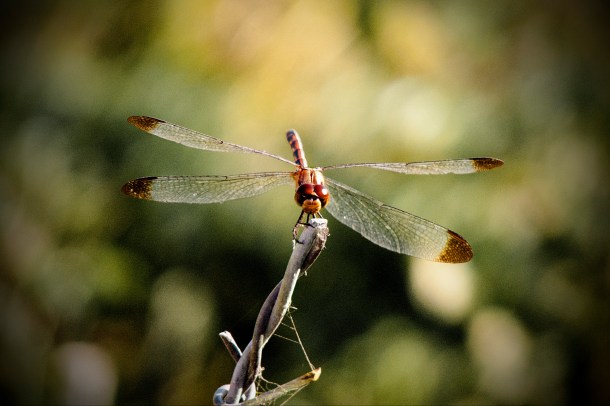
I spotted this dragonfly at the tail end of my bi-weekly morning hike.
 sundry folly