unlikely union

Hole_3

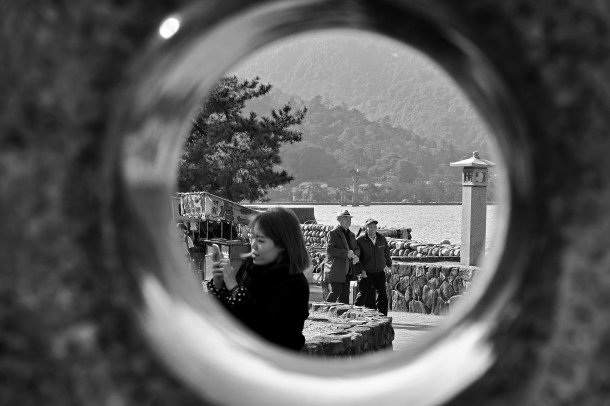
Looking out towards Itsukushima Shrine from a stone sculpture.
If you have been to Miyajima and know the name of the sculpture and/or its significance, please tell me in a comment.  My tour guide explained the lookout’s significance to me, but I was too busy taking photographs for the details to sink in.
Miyajima, Japan
January 2016

Skytree Skyline

SkytreeDSC_0611


Can you see Mount Fuji in the distance?  This was taken just after sunset from the Tembo Deck of the Tokyo Skytree.  From the Tembo Deck, one can take in a 360-degree view of Tokyo at a height of 350 meters/1148 feet.  It is located on the 350th floor.
January 2016
My next post will not be photography.  During the holiday season I took a break from writing, but now that 2016 is truly in full swing, it is time to dust off my pencils!

霜ばしら/Frost Pillars


Frost Pillar_Final

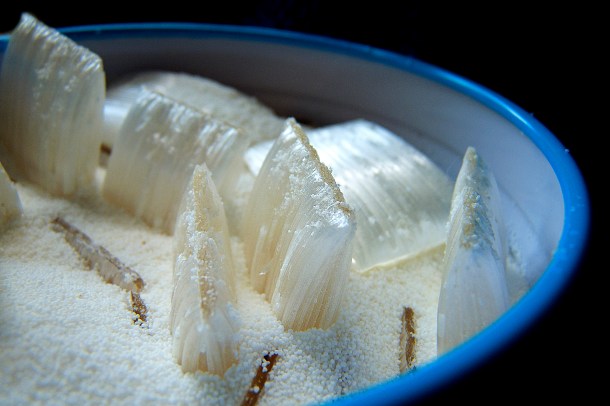
My husband and I received these delicate, delicious candies as a gift this past weekend.

Made from starch syrup, sugar, glutinous rice, and starch, Shimobashira (霜ばしら) are a traditional Japanese candy which are only sold between October and April in Miyagi Prefecture’s Sendai City.

Shimobashira means “frost pillar” and the candies are meant to resemble the  small pillars of frost that form near the foot of Mount Zao during the winter season. In English, frost pillars are often called Needle Ice.  They are formed when soil temperature is above freezing (0°C/32°F) and air’s surface temperature is below freezing.

The fragile candies are packed in rakugan flour—a mixture of sugar and rice flour—in order to keep them moist and to prevent breakage.  The flour can be lightly heated (the rakugan should not be melted), added to a few pinches of salt, and then used as a topping for the candy, however, Shimobashira can also be enjoyed without the rakugan flour.

Here is an example of real “needle ice”.  I found this image at the following website.
themanageablelife

ribbons-of-winter


Silent Silhouette

Lake Suwa_end

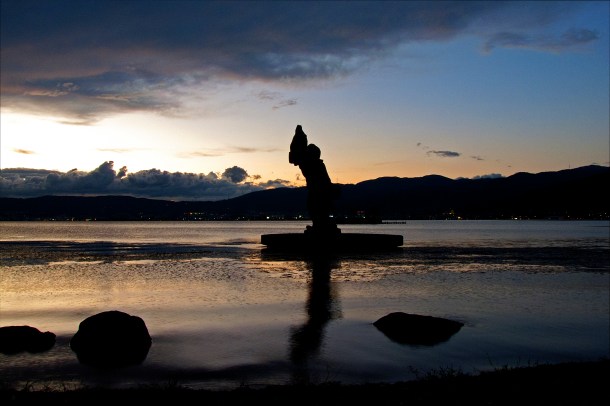
This is a shot of Nagano Prefecture’s Lake Suwa just after sunset.  The statue is of Princess Yaegaki, who is a key figure in Honcho Nijushiko.  Honcho Nijushiko is a five-act drama that was first performed in 1766.  At the end of the story, Yaegaki walks across a frozen Lake Suwa to save her lover from a violent death.